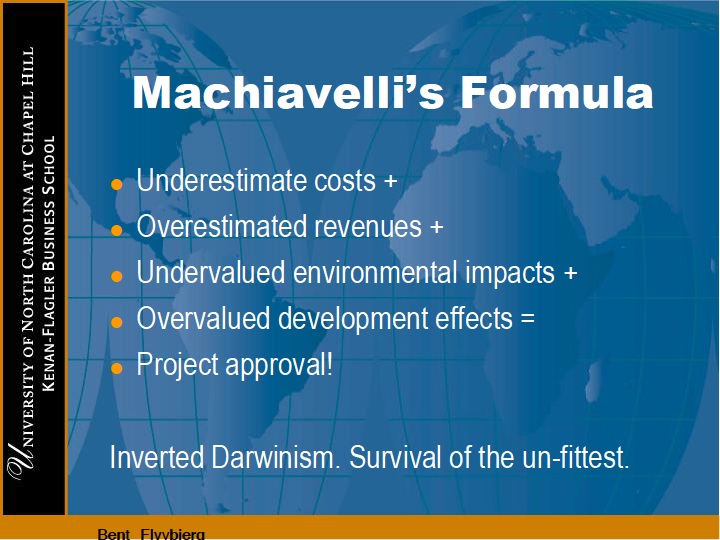
http://www.ncturnpike.org/pdf/MCB%20Traffic%20and%20Revenue%20Forecasts%20Final%20July%202011.pdf
Currituck Maps Corolla’s Future
FROM THE DAILY ADVANCE
Currituck maps Corolla’s future
Staff Writer
Friday, August 12, 2011
By Cindy Beamon
CURRITUCK – Much has changed in Corolla since residents sat on porches overlooking open stretches of sand road and sprawling live oaks. The quiet fishing village has been replaced by a seasonal influx of vacationers who still fish, but not for sustenance. Today’s chief pursuit is leisure at the popular tourist resort.
Businesses and rental housing have sprung up to meet the booming demand, but the village still bears the mark of its former life.
County officials are hoping to preserve a piece of that past with a newly developed Corolla Village Small Area Plan.
Currituck Planning Board member Manley West believes the task will not be easy. In summer, Corolla’s population swells to 55,000, more than double the figure for the entire Currituck mainland. Future growth will add pressure for more services and possibly more changes to the village’s landscape.
“Trying to keep it a small village like it used to be is going to be some task,” West said.
Currituck Senior Planner Holly White said the Corolla Village Small Area Plan is designed to protect the community’s unique character in the midst of certain change. The key will be setting policies that protect Corolla’s distinctive culture and history, natural surroundings and architecture, she said.
The plan was developed after a series of meetings with Corolla residents, business owners and county officials that began last summer. The plan won unanimous approval from the Currituck Planning Board this week and will be forwarded to commissioners in September for final consideration.
“The community is committed to preserving the unique, coastal village feel and sense of place in Corolla Village by planning for and strategically balancing future development,” the plan reads.
The biggest threats to that goal are big box buildings and retail chains, loss of trees and open space, traffic, and plans for construction of a mid-county bridge, residents said in a community survey.
White said the plan recommends two studies to stem those threats.
Traffic problems – with cars and pedestrians competing for space on narrow roads – is one “hot button issue” that needs more study, said White.
Susan Harris, Corolla resident and planning board member, emphasized the need for a quick solution.
“It’s pretty scary in summer as it is now,” said Harris, who said residents had hoped the plan would provide more specific answers to the problem.
White said the problem is too complex for too quick an answer. A traffic study is needed first, she said.
Another study is needed to help preserve the village’s distinctive architecture, White said. The plan recommends forming a study committee to examine existing architecture. That study would aid the county in adopting new building policies that encourage the same look, White said. For example, the county may need to relax its setback standards since the old houses are built closer to the road.
Corolla Village is mostly developed except for a conservation area of wetlands and maritime forests to the west. The village includes the Whalehead Club, Corolla Village and Corolla Light subdivisions, the Currituck Lighthouse, the N.C. Wildlife Education Center and the Corolla Wild Horse Museum.
Since most of the available land is developed, the focus of the small area plan is on future redevelopment.
Businesses in the area are mostly small-scale, locally owned shops that could be replaced by bigger commercial buildings without regulations to prevent it.
The plan proposes “supporting and growing existing small businesses that make Corolla Village unique.”
Planning Board member Jim Clark suggested the county may also need to examine how Corolla may be affected by future growth to the north. County policy currently prohibits businesses on the off-road beaches, which makes Corolla a major destination for groceries, gas and entertainment.
N.C. Off Course In Singling Out Chesapeake’s Expressway Toll
By Roger Chesley
The Virginian-Pilot
© June 27, 2011
THE Tar Heel state is spoiling for a fight with its northern neighbor. My question: Will one city in the Old Dominion respond in the same self-centered way? It will be tempted to. In May, the toll on the Chesapeake Expressway rose from $2 year-round to $6 on summer weekends. It’s now $3 weekdays and off-season.
The toll hadn’t been changed since the $116 million expressway opened in 2001. City officials said the extra money is needed to repay debt and finance expressway repairs. Chesapeake officials built the route because travelers to the Outer Banks used to cause massive summertime backups on South Battlefield Boulevard that stretched all the way to Great Bridge. Residents who lived along the road were virtually held hostage in their homes on the weekends.
After the rate hike was announced this spring, North Carolina tourism and economic development officials quickly pointed out ways to evade the higher rates. So travelers could save a few bucks, but they might get stuck in congestion before they even reached North Carolina. If time is money, that’s a costly trade-off.
A Currituck County official said in April that the county would alert residents and tourists about the rate hike. Outer Banks tourism officials updated a website (www.outerbanks.org) showing how travelers could avoid the toll. The main alternative is South Battlefield.
“It’s unfair to place that burden on the visitors,” Lee Nettles, managing director of the Outer Banks Visitors Bureau, told me Friday. “It seems blatantly targeted on Outer Banks visitors.”
Funny, but the website doesn’t list any detours for other states along the East Coast. What, there’s no need to miss tolls in Pennsylvania, New York or New Jersey? Nettles said drivers that far north have too many options for trip advice to be helpful. “You guys just happened to be close to us,” he added. Lucky us.
Still, it’s ludicrous to think beach visitors can’t afford the higher tolls along the expressway. A 2006 survey by Strategic Marketing & Research Inc. found that visitors to the Outer Banks took trips that averaged around six nights. “Overall, the ‘average’ visitor spent a total of $2,193 during their trip,” the report noted. Granted, the survey took place before the latest recession. But the numbers suggested that visitors knew they would plunk down a sizable amount when they headed to the region.
Here’s why the issue is important to Chesapeake: The Pilot reported last week on ridership statistics on the Chesapeake Expressway since the new rate took effect. Traffic was down June 17-19 about 15 percent from a similar weekend in 2010. Memorial Day counts fell more than 21 percent, from 17,700 in 2010 to 13,887 this year.
Unaudited figures, however, show the city is bringing in more toll revenues. A one-week period in June 2010 generated nearly $194,000. A comparable week this year raised $365,000, or nearly 88 percent more.
The city should see what the entire summer brings. It doesn’t want traffic on South Battlefield to return to its former gridlock. Still, it needs the expected revenue from the toll hike.
The saber-rattling between the states may have just begun.
Roger Chesley, (757) 446-2329, roger.chesley@pilotonline.com, pilotonline.com/chesley
I find it astounding that the Currituck County Commissioners and the County Tourism officials are crying foul over the increased tolls on the Chesapeake Expressway. The proposed Mid-Currituck Bridge tolls, according to the NCTA in a March 2011 document, are projecting tolls on the 2-lane, yes that’s 1 lane each way, to be $11 to $29 EACH WAY. The $29 dollar toll would be used during periods of high congestion, aka summer weekends. Is Currituck County going to advise tourists to bypass that ridiculous toll? I think not! Maybe the county wants the tourists to save all toll money incurred on their trip to the northern Outer Banks and skip the meals on the way as well, so they can afford the astronomical toll on the Mid-Currituck Bridge. Isn’t that an unfair burden that seems blatantly targeted on Outer Banks visitors?
Webmaster NoMCB.com
2011 State Budget Section 28.32(c)
SECTION 28.32.(c) G.S. 136-176(b2), as amended by Section 28.7(g) of S.L. 2010-31, reads as rewritten:
“(b2) There is annually appropriated to the North Carolina Turnpike Authority from the Highway Trust Fund the sum of ninety-nine million dollars ($99,000,000). sixty-four million dollars ($64,000,000). Of the amount allocated by this subsection, twenty-five million dollars ($25,000,000) shall be used to pay debt service or related financing costs and expenses on revenue bonds or notes issued for the construction of the Triangle Expressway, twenty-four million dollars ($24,000,000) shall be used to pay debt service or related financing expenses on revenue bonds or notes issued for the construction of the Monroe Connector/Bypass, and fifteen million dollars ($15,000,000) shall be used to pay debt service or related financing expenses on revenue bonds or notes issued for the construction of the Mid-Currituck Bridge, and thirty-five million dollars ($35,000,000) shall be used to pay debt service or related financing expenses on revenue bonds or notes issued for the construction of the Garden Parkway. Bridge. The amounts appropriated to the Authority pursuant to this subsection shall be used by the Authority to pay debt service or related financing costs and expenses on revenue bonds or notes issued by the Authority to finance the costs of one or more Turnpike Projects, to refund such bonds or notes, or to fund debt service reserves, operating reserves, and similar reserves in connection therewith. The appropriations established by this subsection constitute an agreement by the State to pay the funds appropriated hereby to the Authority within the meaning of G.S. 159-81(4). Notwithstanding the foregoing, it is the intention of the General Assembly that the enactment of this provision and the issuance of bonds or notes by the Authority in reliance thereon shall not in any manner constitute a pledge of the faith and credit and taxing power of the State, and nothing contained herein shall prohibit the General Assembly from amending the appropriations made in this subsection at any time to decrease or eliminate the amount annually appropriated to the Authority. Funds transferred from the Highway Trust Fund to the Authority pursuant to this subsection are not subject to the equity formula in G.S. 136-17.2A.”
H200
NC SENATE TAKES AXE TO 2 TOLL PROJECTS
NC Senate budget takes axe to 2 toll Projects
The Associated Press
RALEIGH, N.C. — The Senate version of North Carolina’s state budget would scrap two proposed toll road projects.
The plan also would restrict state work on Charlotte’s light rail system.
The measure unveiled Tuesday would eliminate recurring money for the proposed Garden Parkway project from Gaston County over the Catawba River to the Charlotte airport. It also would end funds for the Mid-Currituck Bridge connecting the northern Outer Banks to mainland Currituck County.
The measure also would prevent the Department of Transportation from entering into construction, design or planning contracts for two new Charlotte rail lines if the contracts require state funds now or later.
Public transportation grants also would be cut by nearly $27 million next year.
-
My take on it:
Thank God for the GOP! The ending of these PORK BARREL projects promoted by powerful Senator’s ARE COOKED. The NCTA should be gone as well. We are tired of the misrepresentations of studies to get bloated projects pushed forward! NO MORE!!
Read more: http://www.newsobserver.com/2011/05/24/1221884/nc-senate-budget-takes-axe-to.html#ixzz1Nlbvh17e
Bridge Gap Funds Escape Axe For Now
Bridge gap funds escape axe
By Cindy Beamon
The Daily Advance
Saturday, April 16, 2011
Gap funds for the proposed mid-county bridge appear to have escaped the axe in the House’s proposed spending plan for the upcoming year.
Rep. Bill Owens, D-Pasquotank, said funding for the bridge in the House’s draft budget is encouraging although it’s still a long way from approval. The proposed budget will still need to wind its way through committee hearings in the House before final action, he said. The funding package could also be changed in the Senate, he warned.
Last year, the General Assembly approved yearly installments of gap funds needed to fund the project. However, the changeover in leadership has raised concerns that funding could be cut for the seven-mile span linking Currituck’s mainland to the Outer Banks.
The proposed budget delays funding for the project this year, but earmarks funds for the upcoming budget.
The first installment of $15 million in gap funds was scheduled to begin this year, but those funds have been diverted to another road project, said Owens. Instead, funds would start up next year under the proposed spending plan.
Owens said he’s not overly concerned about the possible delay because the state isn’t ready to bid out the project anyway.
“If the bridge was going for bid before July 1, it would be a problem on capturing that money, but that is not going to happen,” he said.
Sen. Stan White, D-Dare, said any delay in funding is unsettling.
“It causes great concern because the more you push something back, the more likely that something else could pop up,” said White.
A year’s delay in funding should not have a huge impact, but it’s hard to predict the effect, said Steve DeWitt, chief engineer with the N.C. Turnpike Authority. He said the state is now negotiating a contract with private developer ACS-Dragados, a Spanish bridge-building company, for building the $660 million span.
Currituck County Commissioners met with Senate leaders this week on their second trip to Raleigh to lobby for the bridge and against suggested cuts to the Knotts Island Ferry.
Commissioner John Rorer said the board emphasized the bridge’s importance to economic development in Northeastern North Carolina and its importance as the state’s first public-private partnership.
Rorer said the state leaders appeared receptive to the message, but he’s still wary about what could happen next.
“I have my concerns because of the nature of the political process,” said Rorer.
Chairman Vance Aydlett said he felt encouraged that the Knotts Island Ferry would not be eliminated but that some changes — like a toll charge or a cut in hours of operation — could result from state spending cuts.
Charlotte Observer Blog: Road Planning From The Disco Era
The Naked City
Mary Newsom on growth in the Charlotte region
Thursday, March 31, 2011
Road planning from the disco era – the rest of the story
In putting together my op-ed, “Road planning from the disco era,” the limitations of space and time required me to leave out some juicy tidbits. You lucky blog readers now may read the rest of the story.
I wrote that the N.C. Turnpike Authority is required by the feds to analyze impacts/effects of the very roads that the authority is, by law, expected to build. The point here is that the legislature, for example with the 1989 Highway Trust Fund, decides to build roads well in advance of any detailed and painstaking analysis of whether the damage they’ll do will be worse than their benefits. Today, significant questions have been raised about both Gaston County’s Garden Parkway and the Monroe Bypass – the latter having been ordered up by legislature in 1989.
Let’s let politicians, not planners, choose the routes. March 17 the General Assembly passed, and the next day the governor signed, a bill that in essence requires the N.C. Turnpike Authority to consider only one route – the most sprawl-inducing one – for the proposed Triangle Expressway Southeast Extension toll road, a link of Raleigh’s I-540 outer loop. The bill, sponsored by Wake Sens. Dan Blue, D, and Sen. Richard Stevens, R, appears to box the turnpike authority into such a spot that it might not be able to meet federal law. The feds require analysis of several alternatives.
“We think that they’ve probably backed themselves into an untenable corner,” says David Farren of the Southern Environmental Law Center. He adds, “What’s most outrageous is just the idea of going as far out as you possibly can, which means the road is longer, the road is more expensive and it’s more sprawl-inducing.” The SELC has filed two lawsuits contesting what it says are improprieties and falsifications involving the federal impact study for the Monroe Bypass.
Why spend only $15 million when you can spend $800 million? Another tidbit that didn’t make the column: The SELC found a 2007 NCDOT study showing that for $15 million, traffic flows on U.S. 74 in Union County could be improved significantly by changing lights, timing and intersections. The N.C. Turnpike Authority, engaged in studying the $800 million Monroe Bypass which aims to alleviate congestion on U.S. 74, didn’t even know that study existed, Farren says.
The state doesn’t do land use planning. And Richard Nixon wasn’t a crook and Bill Clinton never had sex with that woman. When the state plans highways, it engages in land use planning. Next time the state agrees to spend your tax dollars to build a bypass for a city that hasn’t had the sense to say no to congestion-causing highway sprawl development, the state should not pony up dime one until the local government enacts unambiguous land use and zoning ordinances that will prevent said sprawl, including single-family subdivisions, from the new bypass.
The chances of that happening? About like snowballs in hell.
Posted by Mary Newsom at 12:17 PM
Labels: Garden Parkway, Monroe bypass, NCDOT, Turnpike Authority
Read more: http://marynewsom.blogspot.com/2011/03/road-planning-from-disco-era-rest-of.html#ixzz1IbBP88gz
Ferry, Bridge Could Be Cut
Ferry, bridge could be cut
By Cindy Beamon
The Daily Advance
Tuesday, March 29, 2011
The proposed mid-county bridge and the Knotts Island ferry in Currituck could be on the chopping block.
Both are included in a newly released list of possible spending cuts that state legislators plan to consider during upcoming budget deliberations.
State Sen. Stan White said he received the 100-page list of reduction options from the House and Senate Appropriations Subcommittee Monday night. Among the possible cuts would be eliminating the Knotts Island ferry altogether and cutting state “gap” funding for the mid-county bridge. Continue reading
Kevin Siers Cartoon Says It All
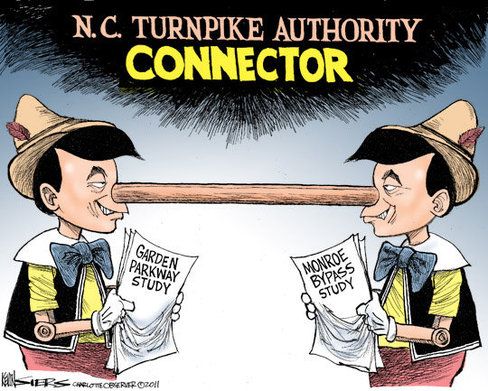
Data Manipulation Must Not Be Tolerated!
Charlotte News & Observer Op. Ed.
Data manipulation must not be tolerated
Toll road documents point to misleading projections.
Posted: Thursday, Mar. 24, 2011
Liar, liar, pants on fire?
That childhood rhyme might sound like a flip assessment of the N.C. Turnpike Authority’s apparent deception to federal officials about the impact of a proposed $800 million toll road in Union County on the environment. But based on documents, the liar part might be about right. We’ll be kind and say misleading. And as for the pants on fire, N.C. officials should put someone or some ones on the hot seat for what appears to be manipulation of data to make it easier for the highway to get the necessary approvals for construction.
Here’s the problem, as Observer reporter Steve Harrison wrote in a front page story Wednesday: Before highways are built, the federal government requires environmental impact projections. Those are compared to a forecast of what would happen if the road were not built.
But the turnpike authority didn’t do a forecast assuming the road wasn’t built. It used only data assuming the Monroe Connector/Bypass highway was already in place, according to the Southern Environmental Law Center, which has filed a lawsuit to stop construction.
The N.C. Department of Transportation, which works with the authority, acknowledged that’s true. But it said engineers adjusted their analysis to make the studies valid, and that the amount of data used assuming the toll road existed was insignificant. Right.
In any case, there’s no getting around the outright lie one federal official says she was told about the project. Marella Buncick, of the U.S. Fish and Wildlife Service, said she asked the Turnpike Authority and the Federal Highway Administration point-blank last summer whether the studies used “build” data in its “no build” forecast. “They told me no,” she said. “Now, if they are saying it doesn’t matter, then why not re-do the analysis with the correct information?” Why not, indeed?
This is the second time recently that the state has been criticized for how it handled the required federal studies for a proposed toll road. The Turnpike Authority was accused in February of manipulating a job loss study in connection with the proposed Garden Parkway in Gaston County. An email from an authority consultant questioning whether the job loss data would look bad raised suspicions that the study might have been changed. State officials deny that.
Given the documents the Observer obtained about the proposed Monroe toll road, we’re not so sure. Those items point to a lack of forthrightness from the state, if not blatant deception.
Growth advocates and environmentalists often clash over these kinds of issues. Communities are well-served by a healthy debate weighing all points of views.
But that debate must be based on accurate data and projections – and the public must be able to trust that it is. Data manipulation and deception jeopardize policymakers’ ability to make prudent decisions that don’t waste taxpayer dollars. Gov. Bev Perdue and N.C. lawmakers who appoint members to the authority’s board should make it crystal clear that such shenanigans won’t be tolerated.
Read more: http://www.charlotteobserver.com/2011/03/24/2166789/data-manipulation-must-not-be.html#ixzz1HX27Fdj9